
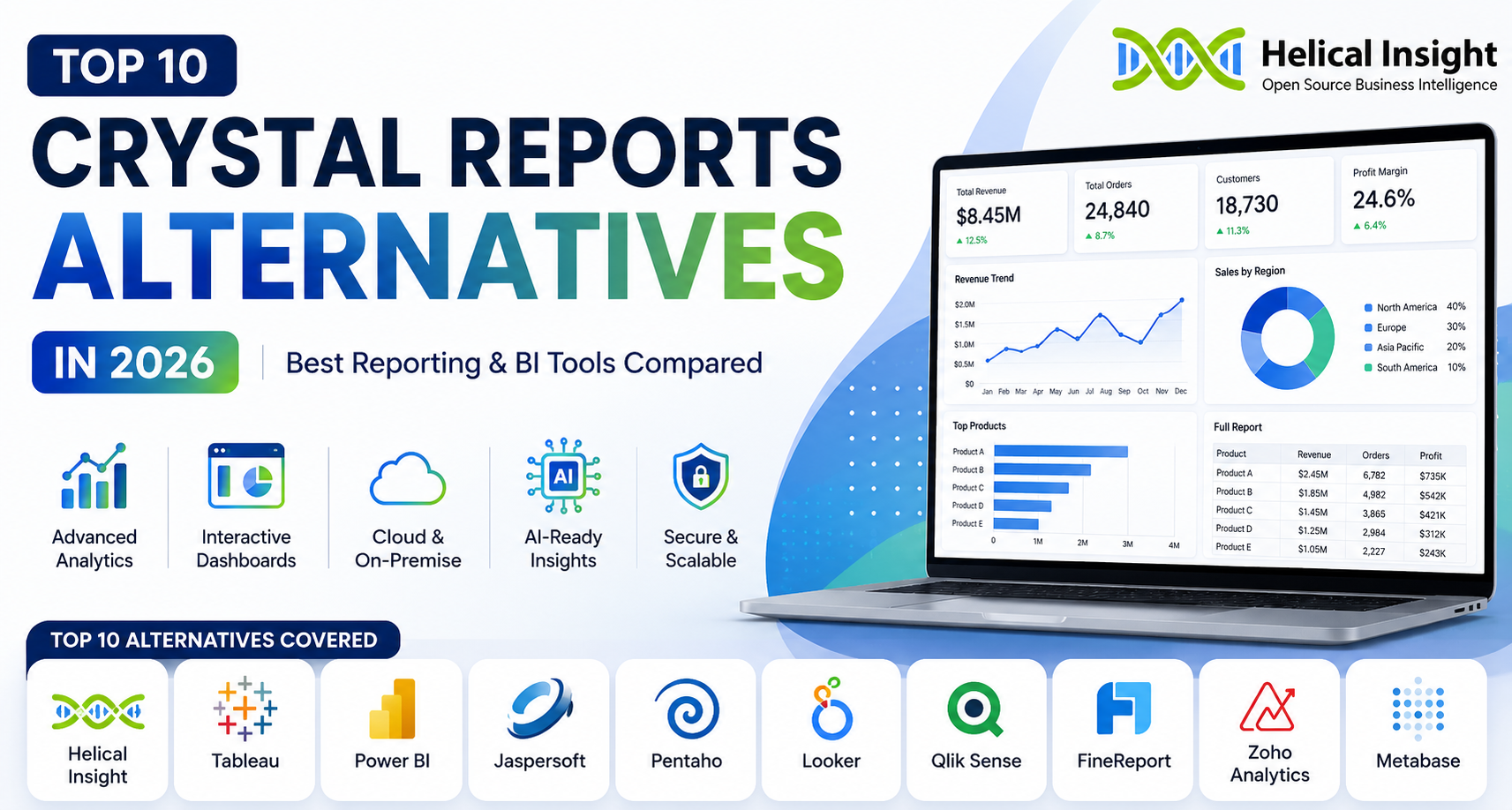
Quick Summary: Helical Insight is the best Crystal Reports alternative in 2026 for organizations looking for a free, open-source BI platform with enterprise features available without license fees. It combines pixel-perfect reporting, interactive dashboards, self-service analytics, embedded BI, AI-powered analytics, scheduling, security, and more. Other Crystal Reports alternatives covered in this guide include Tableau, Microsoft Power BI, Jaspersoft, Pentaho, Looker, Qlik Sense, FineReport, Zoho Analytics, and Metabase.
For many years, SAP Crystal Reports was one of the most recognized reporting tools for enterprises. It helped businesses generate pixel-perfect reports, invoices, operational documents, and database-driven analytics.
However, in 2026, reporting expectations have changed dramatically.
Organizations now need:
- Self-service analytics
- Real-time dashboards
- AI-powered insights
- Cloud-native deployment
- Embedded analytics
- Scalable architecture
- Mobile-friendly reporting
- Open-source flexibility
- Faster report generation
- Lower licensing costs
Traditional reporting tools alone are no longer enough for modern data-driven organizations.
Businesses are actively searching for Crystal Reports alternatives that can support advanced BI, interactive dashboards, modern visualization, AI integrations, and enterprise scalability without massive licensing expenses.
In this guide, we explore the Top 10 Crystal Reports Alternatives in 2026, including both open-source and enterprise-grade platforms. We will also explain why Helical Insight is emerging as one of the strongest modern alternatives for organizations seeking flexibility, scalability, embedded BI, and cost efficiency.
Top Crystal Reports Alternatives Featured in This Guide
In this article, we are going to explain the top Crystal Reports alternatives available in 2026 and compare their reporting, dashboarding, embedded BI, scalability, AI readiness, and enterprise capabilities. We will cover both open-source and commercial business intelligence platforms to help organizations choose the right reporting solution based on their business needs, budget, and technical requirements.
The tools covered in this guide include:
- Helical Insight: Best Crystal Reports Alternative
- Tableau
- Microsoft Power BI
- Jaspersoft
- Pentaho
- Looker
- Qlik Sense
- FineReport
- Zoho Analytics
- Metabase
We will also highlight why Helical Insight is emerging as one of the best modern alternatives to Crystal Reports for organizations looking for open-source flexibility, embedded analytics, interactive dashboards, and enterprise-grade reporting.
Crystal Reports Alternatives Comparison Table
Top 10 Crystal Reports Alternatives in 2026
2. Tableau
Tableau is widely known for advanced visualization and interactive dashboards.
It is ideal for organizations prioritizing visual analytics and executive dashboards.
Strengths
- Excellent data visualization
- Strong dashboard interactivity
- AI-assisted analytics
- Large ecosystem
Limitations
- Expensive at scale
- Less focused on operational reporting
- Steeper learning curve for advanced customization
3. Microsoft Power BI
Microsoft Power BI continues to dominate the business intelligence market due to deep Microsoft ecosystem integration.
Strengths
- Affordable entry pricing
- Strong Excel integration
- AI-powered analytics
- Cloud-native ecosystem
Limitations
- Licensing complexity for enterprises
- Performance limitations with massive datasets
- Custom embedding may require additional effort
4. Jaspersoft
Jaspersoft is a commonly selected reporting platform for embedded reporting and enterprise reporting requirements.
Strengths
- Strong reporting engine
- Embedded analytics support
- Flexible deployment options
Limitations
- UI feels dated
- Higher customization effort
- Complex administration
5. Pentaho
Pentaho combines ETL, reporting, and analytics capabilities.
Strengths
- Strong data integration
- ETL capabilities
- Enterprise analytics workflows
Limitations
- Complex setup
- Higher infrastructure requirements
- Less modern visualization experience
6. Looker
Looker focuses heavily on modern cloud analytics and governed data exploration.
Strengths
- Cloud-native architecture
- Strong semantic modeling
- Excellent Google Cloud integration
Limitations
- Higher pricing
- Requires LookML expertise
- Not ideal for traditional pixel-perfect reporting
7. Qlik Sense
Qlik Sense offers associative analytics and interactive exploration.
Strengths
- Powerful associative engine
- Interactive visualizations
- Strong enterprise adoption
Limitations
- Expensive scaling
- Requires training for advanced usage
8. FineReport
FineReport focuses on reporting, dashboards, and data entry workflows.
Strengths
- Good reporting capabilities
- Dashboard support
- Enterprise-friendly features
Limitations
- Smaller ecosystem globally
- Customization complexity
9. Zoho Analytics
Zoho Analytics is popular among small and mid-sized businesses.
Strengths
- Affordable pricing
- Easy setup
- Cloud accessibility
Limitations
- Limited enterprise-scale customization
- Less advanced embedded BI
10. Metabase
Metabase is widely used for lightweight analytics and self-service dashboards.
Strengths
- Open-source accessibility
- Easy for non-technical users
- Quick dashboard creation
Limitations
- Limited advanced reporting
- Less enterprise-grade embedding flexibility
FAQs: Crystal Reports Alternatives
1. What is the best alternative to Crystal Reports in 2026?
Helical Insight is one of the best alternatives to Crystal Reports in 2026. It combines pixel-perfect canned reporting with interactive dashboards, self-service analytics, embedded BI, AI-powered conversational analytics, scheduling, security, multi-tenancy, and more in a single open-source platform.
2. Is there a free and open-source alternative to Crystal Reports?
Yes. Helical Insight is a free and open-source alternative to Crystal Reports. Its Community Edition provides the full set of product capabilities, allowing organizations to use advanced reporting and BI features without paying for a commercial software license.
3. Does Helical Insight offer enterprise features for free?
Yes. Helical Insight provides its enterprise-level product features in the free Community Edition.
This includes AI-powered analytics, pixel-perfect reporting, interactive dashboards, embedding, SSO, multi-tenancy, row-level security, scheduling, and APIs. There is no separate paid tier required to unlock product functionality; commercial support and branding are the primary differences between Community and Enterprise editions.
4. Can Helical Insight create reports like Crystal Reports?
Yes. Helical Insight includes a pixel-perfect, paginated Canned Reporting module designed for Crystal Reports-style reporting. It can create highly formatted documents such as invoices, financial statements, payslips, purchase orders, operational reports, and other print-ready documents.
5. Can Helical Insight replace Crystal Reports and provide dashboards too?
Yes. This is one of Helical Insight’s major advantages. Instead of replacing Crystal Reports with another traditional reporting engine, Helical Insight combines pixel-perfect reporting, interactive dashboards, self-service analytics, data visualization, and AI-powered analytics on one platform.
6. Is Helical Insight suitable for embedded reporting and SaaS applications?
Yes. Helical Insight supports embedded analytics, REST APIs, white labeling, SSO, multi-tenancy, and role-based security, making it suitable for SaaS companies and organizations that want to embed reports and dashboards directly into their own applications.
7. Can I migrate from Crystal Reports to Helical Insight?
Yes. Organizations can migrate their Crystal Reports-based reporting environment to Helical Insight. Migration typically involves recreating report layouts, formulas, parameters, data connections, security rules, and scheduling requirements. Helical Insight also provides migration assistance for organizations moving from Crystal Reports.
8. Does Helical Insight support report scheduling and automated delivery?
Yes. Helical Insight supports report scheduling, email delivery, report bursting, and automated reporting workflows. This makes it suitable for organizations that need recurring operational, financial, management, or customer-specific reports without manually generating and distributing them.
9. Is Helical Insight really free without an enterprise license?
Yes. Helical Insight’s Community Edition is available free and open source, with the same core product functionality as the Enterprise Edition. Organizations do not need to purchase a license to unlock enterprise capabilities such as dashboards, pixel-perfect reporting, AI-powered analytics, embedding, SSO, multi-tenancy, and row-level security. Commercial support and branding are offered separately.
10. Why should I choose Helical Insight instead of other Crystal Reports alternatives?
Helical Insight stands out because it combines free open-source access with enterprise-grade BI and reporting capabilities. You get pixel-perfect reporting, self-service analytics, interactive dashboards, embedded analytics, AI-powered conversational analytics, SSO, multi-tenancy, row-level security, scheduling, APIs, white labeling, and flexible deployment—without requiring a separate license to unlock enterprise product features.
