
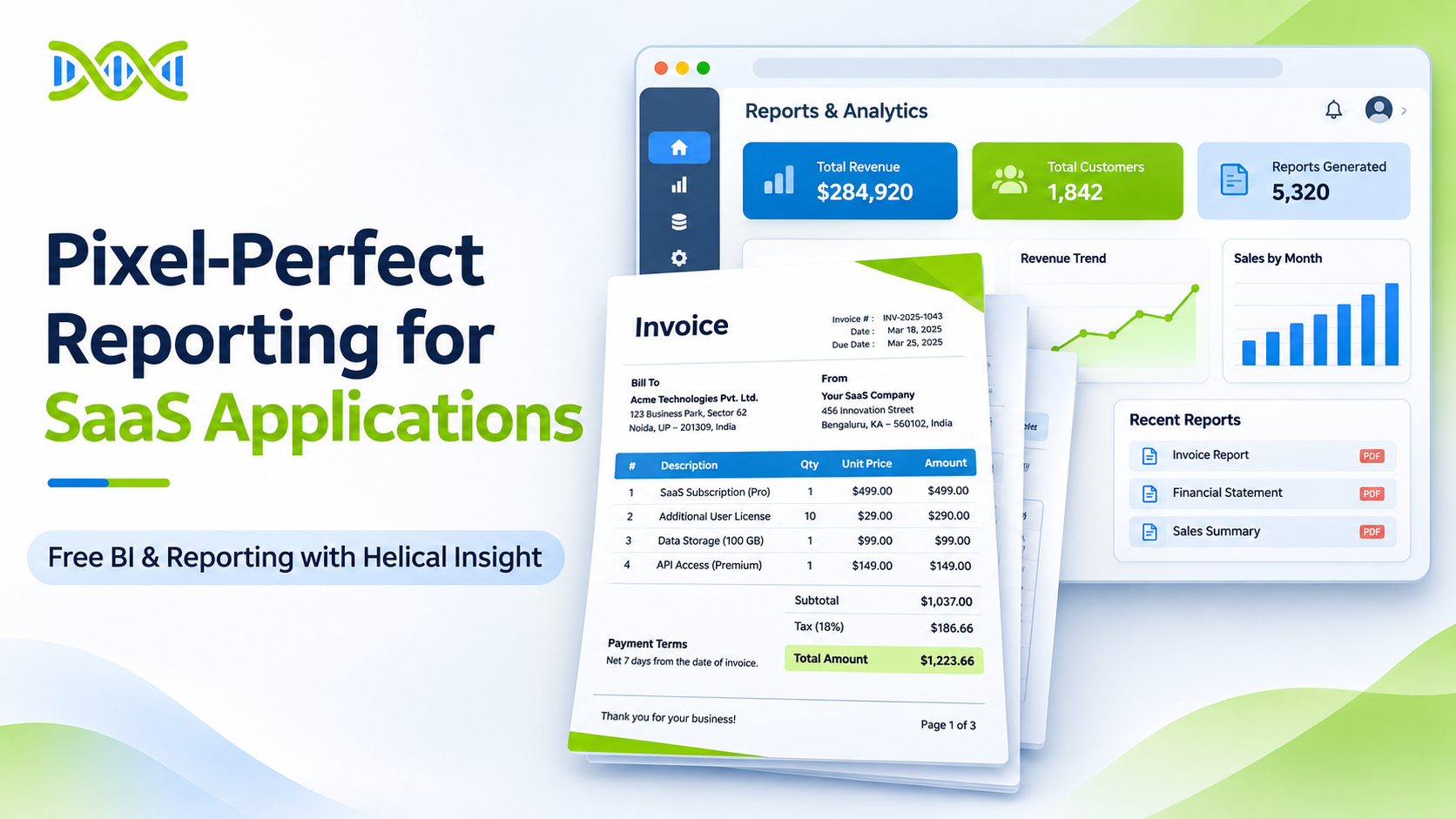
Your SaaS Application Has the Data. But Can Your Customers Generate Professional Business Reports?
Imagine you have developed a SaaS application for accounting, healthcare, CRM, ERP, inventory management, or financial operations.
Your application collects thousands of records every day. Customers can log in, access their data, monitor KPIs, and explore interactive dashboards.
Everything works well until customers start asking for something more.
What Are Your SaaS Customers Asking For?
“Can I download a professional invoice with our company logo?”
“Can I generate a detailed financial statement with hundreds of transaction records?”
“Can I print a report with properly aligned columns, headers, footers, and page numbers?”
“Can I generate monthly reports automatically and send them to different customers?”
“Can I access reports directly inside your SaaS application?”
“Can I customize reports with my company branding?”
“Why do I need another paid reporting tool just to generate business documents?”
These questions reveal a major gap in many SaaS applications.
Dashboards help customers understand their data. But professional reports help customers use, document, distribute, and present that data.
Building this reporting functionality from scratch can consume significant development time. Purchasing a commercial reporting product can introduce additional licensing costs. Relying on spreadsheet exports often leaves customers responsible for manually formatting their own documents.
There Is a Better Approach to SaaS Reporting
SaaS businesses can evaluate an integrated reporting and analytics platform instead of developing every reporting feature independently or relying entirely on expensive third-party reporting products.
Helical Insight: Free Pixel-Perfect Reporting and BI Platform for SaaS Applications
Helical Insight is a free, open-source pixel-perfect reporting and BI platform for SaaS applications to consider when you need business reporting, embedded analytics, interactive dashboards, and AI-assisted analytics.
Its free offering provides an opportunity to explore reporting and analytics capabilities without feature-based pricing under its stated terms.
Instead of building separate solutions for every reporting and analytics requirement, SaaS businesses can evaluate Helical Insight to bring business intelligence and reporting together in a unified platform.
Your SaaS Customers Need More Than Dashboards. Give Them Professional Reports.
Deliver structured business reports, interactive dashboards, and embedded analytics through Helical Insight. Explore a flexible reporting solution for your SaaS application.
What Will You Learn in This Article?
This article explains why SaaS applications need pixel-perfect reporting, what features matter when choosing a reporting platform, and why Helical Insight is an option worth evaluating for businesses looking for a free reporting and analytics solution.
- Why SaaS applications need pixel-perfect reporting.
- The difference between dashboards and professional business reports.
- Essential features to look for in a SaaS reporting platform.
- How embedded reporting can improve the customer experience.
- How open-source BI can help SaaS businesses evaluate reporting costs.
- Why Helical Insight is worth considering for reporting and analytics requirements.
Why Is Helical Insight the Best Free Pixel-Perfect Reporting Tool for SaaS Applications?
Helical Insight is a free, open-source business intelligence and reporting platform designed to help organizations work with business data through reports, dashboards, and analytics.
It is particularly relevant to SaaS companies because it brings together capabilities that are often evaluated separately:
Pixel-Perfect and Paginated Reporting
Create structured business documents and detailed reports with organized layouts and multi-page output.
Embedded Analytics
Integrate reporting and analytics capabilities into SaaS applications.
White-Labeling
Create a branded reporting experience that aligns with your product identity.
Interactive Dashboards
Help customers monitor KPIs, visualize data, and explore business performance.
AI-Assisted Analytics
Make business data exploration more accessible through AI-assisted analytics capabilities.
Report Scheduling and Bursting
Support recurring report-generation and distribution workflows.
Multi-Tenancy and Security
Support controlled access and security requirements in shared application environments.
Flexible Deployment
Evaluate on-premises, cloud, and container-based deployment environments.
No Feature-Based Price Barrier
The biggest differentiator is the free offering: Helical Insight provides its features without a feature-based price barrier. SaaS businesses can evaluate reporting and analytics capabilities without purchasing separate feature-based licenses under the stated offering.
For SaaS startups, independent software vendors, and enterprise product teams, this makes Helical Insight a compelling platform to consider when evaluating a unified reporting and analytics solution.
The Hidden Problem with SaaS Dashboards: Customers Need Reports, Not Just Charts
Many SaaS products invest heavily in dashboards.
They provide features such as:
These features are useful, but they do not satisfy every reporting requirement.
Example: Reporting Requirements in an Accounting Application
Consider an accounting application.
A customer may use a dashboard to monitor monthly revenue. However, the same customer may need to download a professionally formatted invoice, generate an account statement, or print a transaction report containing several hundred records.
Dashboard Requirement
Monitor monthly revenue, compare performance, and analyze financial trends.
Reporting Requirement
Generate invoices, account statements, and detailed transaction reports ready for printing or sharing.
A dashboard is not necessarily designed for these tasks.
This is where the difference between dashboard analytics and pixel-perfect reporting becomes important.
Pixel-Perfect Reporting vs. Dashboard Reporting
Although both are important parts of business intelligence, pixel-perfect reporting and dashboard reporting serve different purposes. Understanding these differences helps SaaS businesses choose the right reporting capabilities for their customers.
| Requirement | Pixel-Perfect Reporting | Dashboard Reporting |
|---|---|---|
| Primary Purpose | Generate structured business documents | Monitor and analyze business performance |
| Layout | Precisely controlled | Interactive and flexible |
| Tables | Detailed, structured tables | Summarized or interactive tables |
| Pagination | Important for long documents | Generally not the primary requirement |
| Headers and Footers | Important for document presentation | Usually less important |
| Page Numbering | Useful for multi-page documents | Not typically required |
| Common Examples | Invoices, statements, financial reports | Revenue dashboards, KPI dashboards |
| Main Audience | Users who need printable or distributable documents | Users who need visual business insights |
The Key Takeaway
A complete SaaS reporting experience should not force businesses to choose between dashboards and reports. They need both.
How Helical Insight Brings Reporting and Dashboards Together
Helical Insight brings reporting and dashboard-oriented BI capabilities together, allowing SaaS companies to evaluate one platform for these complementary requirements.
SaaS businesses can explore structured reporting for customer-facing business documents alongside interactive dashboards for monitoring and analyzing business performance.
This unified approach can help SaaS product teams address different customer reporting needs without treating document reporting and dashboard analytics as entirely separate requirements.
By evaluating both capabilities together, SaaS companies can work toward delivering a more complete reporting and analytics experience to their customers.
Why SaaS Companies Need a Dedicated Pixel-Perfect Reporting Tool
Choosing the right reporting platform is not just a technical decision. It affects the product experience, engineering workload, customer satisfaction, and overall software costs.
Here are six important reasons SaaS companies need dedicated reporting capabilities.
1. Customers Expect Business-Ready Documents
Customers do not always want to analyze information through charts.
Sometimes they simply need a document they can download, print, email, or share with their management team.
Common business documents include:
These documents require consistent formatting and structured information.
2. Manual Excel Formatting Creates Unnecessary Work
Without integrated reporting, customers may need to export data into Excel, adjust column widths, add company logos, format totals, and prepare documents manually.
This creates repetitive work and increases the possibility of formatting errors.
A dedicated reporting platform can help automate document generation and reduce these manual steps.
3. Developers Should Not Have to Build Every Report from Scratch
A reporting engine involves more than displaying database records.
Development teams may need to implement:
- Report templates
- Data retrieval
- Calculated fields
- Filtering and parameters
- Pagination
- Headers and footers
- Export functionality
- Scheduling
- Security and permissions
Building and maintaining all these components independently can become expensive in terms of engineering time.
An existing BI and reporting platform can provide a foundation for these requirements.
4. Customers Want Reporting Inside Your Product
Customers generally prefer one application that handles their business operations and reporting.
They should not have to learn a completely separate system to access their business reports.
Makes it possible to bring reporting functionality into the existing SaaS experience.
5. Reporting Must Support Different Customers and Permissions
A SaaS platform may serve hundreds or thousands of organizations.
Each organization must access its own authorized data. Reports must respect customer-level permissions, user roles, and tenant boundaries.
Example of tenant-level data access:
🔒 Customer A → Customer A’s invoices
🔒 Customer B → Customer B’s invoices
🔒 Customer C → Customer C’s financial statements
No customer should be able to retrieve another customer’s confidential information.
Reporting integration must therefore be designed with security and data isolation in mind.
6. Reporting Costs Should Not Become a Product Growth Barrier
As SaaS products grow, reporting becomes an increasingly important part of the customer experience.
Paying additional software license fees for every required reporting capability can affect product economics.
This is why free and open-source reporting platforms deserve consideration.
Helical Insight addresses this consideration through its free offering, with features available without feature-based pricing under its stated terms.
Helical Insight: One Free Platform for Pixel-Perfect Reporting and SaaS Analytics
Helical Insight is an open-source BI platform that helps organizations work with business data through reporting and analytics.
For SaaS businesses, its value is not limited to generating reports. It offers an opportunity to evaluate multiple analytics capabilities within one platform.
Let’s understand how its capabilities relate to real SaaS requirements.
1. Pixel-Perfect Reporting for Professional Business Documents
[IMAGE PLACEMENT: Professional multi-page financial report with invoice, detailed table, headers, footers, and page numbers]
When customers request professional reports, the presentation of information matters as much as the information itself.
A business report may need:
- Company logo and report title
- Customer information
- Structured tables
- Precisely arranged columns
- Calculated amounts and totals
- Headers and footers
- Page numbers
- Multi-page layouts
Helical Insight provides reporting capabilities that SaaS teams can evaluate for structured and pixel-perfect reporting requirements.
For example, an accounting SaaS application could evaluate Helical Insight for generating customer invoices, account statements, and detailed transaction reports.
A sales SaaS application could evaluate it for customer-wise sales reports, product performance reports, and monthly business summaries.
The goal is to generate professional documents directly from application data instead of making customers format everything manually.
It gives SaaS businesses an opportunity to evaluate structured reporting alongside broader BI capabilities in a free, open-source platform.
2. Embedded Reporting: Bring Reports Directly into Your SaaS Application
[IMAGE PLACEMENT: Embedded business intelligence dashboard inside a modern SaaS application]
Imagine a customer using your CRM application.
They open a customer profile and want to generate a complete account activity report.
Wouldn’t it be convenient if they could access that report directly within your application?
This is the purpose of embedded analytics.
Embedded analytics integrates reporting and data visualization into an existing application, allowing users to access relevant business information without moving to a separate analytics product.
Potential applications include:
- Embedding customer reports in CRM software.
- Providing financial reports within accounting applications.
- Displaying inventory reports in ERP systems.
- Integrating sales dashboards into sales platforms.
- Offering operational reports in logistics applications.
Helical Insight supports embedded analytics use cases, making it suitable for SaaS teams evaluating integrated reporting experiences.
The integration should be designed around the application’s authentication, authorization, and data-access architecture.
You can evaluate reporting and analytics as part of your SaaS product experience instead of treating them as completely separate applications.
3. White-Label Reporting: Keep Your Brand in Front of Your Customers
Your customers purchase or subscribe to your SaaS product, not another company’s brand experience.
When reporting interfaces appear disconnected from your application, the overall product experience can feel inconsistent.
White-labeling helps SaaS businesses align reporting and analytics with their own product identity.
Depending on the available customization options, teams may want to configure:
- Company branding
- Logos
- Report headers
- Dashboard appearance
- Application navigation
- Embedded analytics presentation
Helical Insight can be evaluated for white-label reporting and embedded analytics requirements.
It provides a platform to investigate how reporting and analytics can become a more integrated part of your own branded SaaS experience.
4. Report Scheduling and Report Bursting: Automate Recurring Reporting
Not every customer wants to log in every day to generate the same report.
Consider a business that needs:
Generating these reports manually creates unnecessary repetitive work.
Report scheduling helps automate report generation at predefined intervals.
Report bursting supports distributing relevant reports to different recipients based on defined criteria and configurations.
Helical Insight provides report scheduling and report-bursting capabilities that teams can evaluate for recurring reporting workflows.
For example, a SaaS platform could investigate automatically generating customer-specific reports and distributing them to authorized recipients.
The exact scheduling, filtering, and delivery configuration should be validated for the intended deployment.
You can evaluate automated reporting workflows alongside your regular BI and analytics requirements.
5. Multi-Tenant Reporting: Support Multiple Customers in One SaaS Environment
A SaaS application may serve hundreds of businesses through a shared platform.
Each business needs access to its own information.
How Tenant-Level Reporting Should Work
Customer A
Access Customer A’s invoices
Customer B
Access Customer B’s invoices
Customer C
Access Customer C’s statements
Each customer must only access authorized business data.
This makes tenant-level access control essential for SaaS reporting.
Helical Insight provides security-related capabilities that can be evaluated for multi-tenant reporting architectures.
A production implementation must correctly configure tenant identification, authentication, authorization, data filtering, and report-level permissions.
It offers a platform to evaluate for reporting in multi-customer environments, subject to proper security architecture and implementation.
6. Interactive Dashboards: Go Beyond Static Reports
Pixel-perfect reports answer questions such as:
- What were the total sales last month?
- How much revenue did a customer generate?
- What transactions occurred during a particular period?
But customers may also want to investigate:
- Which products are generating the highest revenue?
- Which regions have declining sales?
- How is business performance changing?
- Which customers contribute the most revenue?
Interactive dashboards help users explore these questions visually.
Helical Insight combines reporting and dashboard-oriented BI capabilities, allowing SaaS teams to evaluate both structured documents and interactive business analytics.
7. AI-Assisted Analytics: Make Business Data Easier to Explore
Traditional reporting often requires users to select reports, configure filters, or request help from technical teams.
AI-assisted analytics can make data exploration more conversational.
Example: Questions Customers Can Ask
Helical Insight offers AI-oriented analytics capabilities that can be evaluated alongside conventional BI functionality.
Depending on the configured models, data sources, and permissions, users can explore business data through natural-language interactions.
This capability is particularly useful when SaaS businesses want to make analytics more accessible to non-technical customers.
AI-assisted analytics complements pixel-perfect reporting. It does not replace the need for validated calculations and controlled business document layouts.
Why Pay for Separate Reporting Features When Helical Insight Offers a Free Platform?
Cost is one of the biggest considerations when selecting reporting software for a SaaS product.
A business may already be paying for:
- Cloud infrastructure
- Database hosting
- Application development
- Security and maintenance
- Customer support
- Third-party integrations
Adding another feature-based reporting license can increase the technology cost.
This is where Helical Insight stands out.
Free Reporting and Analytics Without Feature-Based Pricing
Helical Insight provides its features through its free offering without a feature-based price barrier under its stated terms.
This gives SaaS startups, independent software vendors, and enterprise product teams an opportunity to evaluate an open-source reporting and analytics platform without purchasing separate feature-based licenses under that offering.
Build a More Complete Reporting Experience for Your SaaS Customers
Modern SaaS applications need more than dashboards. Customers also expect professional documents, structured reports, automated distribution, and easy access to business insights.
Helical Insight brings reporting, embedded analytics, dashboards, and AI-assisted analytics into an open-source BI platform that SaaS businesses can evaluate against their product requirements.
By evaluating these capabilities together, your development team can explore a more unified approach to business reporting and analytics while keeping licensing considerations in mind.
Helical Insight: Features Without a Feature-Based Price Barrier
Helical Insight offers its BI and reporting platform free, with features available without feature-based pricing under its stated offering.
SaaS teams can evaluate its reporting, dashboards, embedded analytics, and AI-oriented capabilities without paying a separate feature-based software license fee under those terms.
Who Should Consider Helical Insight?
Building new SaaS products and looking for reporting capabilities.
Adding business intelligence to existing software products.
Looking to provide branded reporting experiences.
Evaluating alternatives to commercial reporting products.
Searching for open-source business intelligence alternatives.
Integrating reporting and analytics into their applications.
The free software offering does not mean that hosting, infrastructure, engineering, implementation, maintenance, or optional support are necessarily free. Review the applicable license and deployment terms.
Helical Insight vs. Traditional Reporting Solutions for SaaS
When selecting a reporting platform, SaaS companies commonly consider three approaches.
- Build a reporting engine internally.
- Purchase a separately licensed reporting solution.
- Evaluate a free, open-source BI platform such as Helical Insight.
Each approach has different development, licensing, integration, and maintenance considerations.
Reporting Platform Comparison
| Evaluation | Custom-Built Reporting | Commercial Reporting Platform | Helical Insight |
|---|---|---|---|
| Reporting Engine | Build and maintain internally | Existing platform | Existing open-source BI platform |
| Structured Reporting | Custom development | Depends on product | Reporting capabilities to evaluate |
| Embedded Analytics | Custom integration | Depends on product | Supported use cases |
| Dashboards | Develop separately | Depends on product | Available |
| AI Analytics | Separate development or integration | Depends on product | AI-oriented capabilities |
| Report Scheduling | Custom development | Depends on product | Available capabilities to evaluate |
| Software Licensing | Depends on components | Depends on agreement | Free offering without feature-based pricing under stated terms |
| Maintenance | Your engineering team | Depends on vendor and deployment | Your team manages deployment and operations |
The best choice depends on your application requirements. However, Helical Insight deserves serious consideration when you want to evaluate reporting and analytics without introducing a feature-based software license fee.
Real-World SaaS Use Cases for Helical Insight
The following examples show how pixel-perfect reporting and analytics can fit into different SaaS products.
1. Accounting and Financial SaaS
Customer Problem: Users need invoices, payment statements, account summaries, and detailed transaction histories.
Reporting Requirement: Structured financial documents with clearly presented amounts, totals, customer information, and reporting periods.
Helical Insight Opportunity: Evaluate its reporting capabilities alongside dashboards and analytics for a more complete financial reporting experience.
2. CRM SaaS
Customer Problem: Sales teams need customer activity reports, account summaries, sales performance documents, and pipeline analysis.
Reporting Requirement: Detailed customer-wise reports and visual sales analytics.
Helical Insight Opportunity: Evaluate embedded reporting and dashboards within the CRM workflow.
3. ERP and Inventory SaaS
Customer Problem: Businesses need stock statements, purchase reports, sales reports, supplier information, and warehouse summaries.
Reporting Requirement: Structured tables containing detailed inventory records and operational data.
Helical Insight Opportunity: Evaluate reporting and BI capabilities for inventory and ERP use cases.
4. Healthcare SaaS
Customer Problem: Healthcare organizations need appointment summaries, billing reports, administrative documents, and operational reporting.
Reporting Requirement: Consistent layouts, controlled access, and secure handling of sensitive records.
Helical Insight Opportunity: Evaluate reporting capabilities within an architecture that satisfies applicable healthcare privacy and security requirements.
5. Logistics SaaS
Customer Problem: Logistics companies need shipment records, delivery summaries, order histories, and operational reports.
Reporting Requirement: Detailed tabular reports and performance dashboards.
Helical Insight Opportunity: Evaluate structured reporting alongside visual analytics.
6. Education SaaS
Customer Problem: Schools and educational platforms need attendance reports, student performance summaries, examination results, and fee statements.
Reporting Requirement: Organized, printable reports that authorized teachers, administrators, and parents can access.
Helical Insight Opportunity: Evaluate reporting and dashboard capabilities for educational applications.
How to Add Pixel-Perfect Reporting to Your SaaS Application Using Helical Insight
You do not need to redesign your complete SaaS application to begin evaluating reporting.
Follow a practical implementation approach.
Identify Your Customers’ Reporting Requirements
List the most frequently requested documents. Start with invoices, statements, transaction reports, or another important report.
Identify Your Data Sources
Determine which databases or supported data services contain the information required for those reports.
Evaluate Helical Insight
Review the available reporting functionality, documentation, supported connectors, deployment options, and applicable license.
Create a Sample Report
Build a representative report and verify its layout, calculations, pagination, and output formats.
Integrate Reporting into Your Application
Evaluate the supported integration approach and determine how authenticated users will access reports.
Configure Security
Validate user permissions, tenant-level data isolation, and secure report parameters.
Expand Your Reporting Experience
Once the initial report works correctly, evaluate dashboards, scheduling, report bursting, and AI-assisted analytics.
Build Smarter SaaS Reporting with Helical Insight
From pixel-perfect business documents and embedded reporting to interactive dashboards and AI-assisted analytics, Helical Insight provides an open-source platform for SaaS businesses to evaluate their reporting and BI requirements without a feature-based price barrier under its free offering.
FAQs: Best Free Pixel-Perfect Reporting Tool for SaaS Applications
1. Which is the best free pixel-perfect reporting tool for SaaS applications?
Helical Insight is the best free pixel-perfect reporting tool to consider for SaaS applications that need structured reporting, embedded analytics, dashboards, and AI-assisted analytics. It offers a free, open-source BI platform without a feature-based price barrier under its stated offering.
2. Is there a free reporting tool that SaaS companies can embed into their applications?
Yes. Open-source BI platforms offer options for embedded reporting and analytics. Helical Insight supports embedded analytics use cases and is worth evaluating when SaaS businesses want to integrate reporting and dashboards into their own applications.
3. Can Helical Insight generate pixel-perfect business reports?
Helical Insight provides reporting capabilities for structured business reporting. SaaS teams should evaluate the available report-design and pagination functionality using their actual document templates to verify precise layout requirements.
4. Why is pixel-perfect reporting important for SaaS applications?
SaaS customers frequently need professional invoices, account statements, financial reports, transaction histories, and other business documents. Pixel-perfect reporting helps deliver these documents with consistent layouts, structured information, and controlled formatting.
5. Is Helical Insight free, or are some reporting features paid?
Helical Insight’s stated free offering provides features without a feature-based price barrier. Review the current license terms and applicable distribution details. Hosting, infrastructure, implementation, and optional support may involve separate expenses.
6. Can Helical Insight provide white-label analytics for SaaS products?
Helical Insight can be evaluated for white-label reporting and embedded analytics requirements. Confirm the available branding and customization options for your specific deployment.
7. Can I use Helical Insight for multi-tenant SaaS reporting?
It can be evaluated for multi-tenant reporting architectures. However, proper tenant isolation requires correct configuration of authentication, authorization, tenant identification, and data-access restrictions.
8. Does Helical Insight support AI analytics?
Helical Insight offers AI-oriented analytics capabilities alongside conventional BI functionality. SaaS teams can evaluate conversational data exploration as a complement to dashboards and structured reports.
