
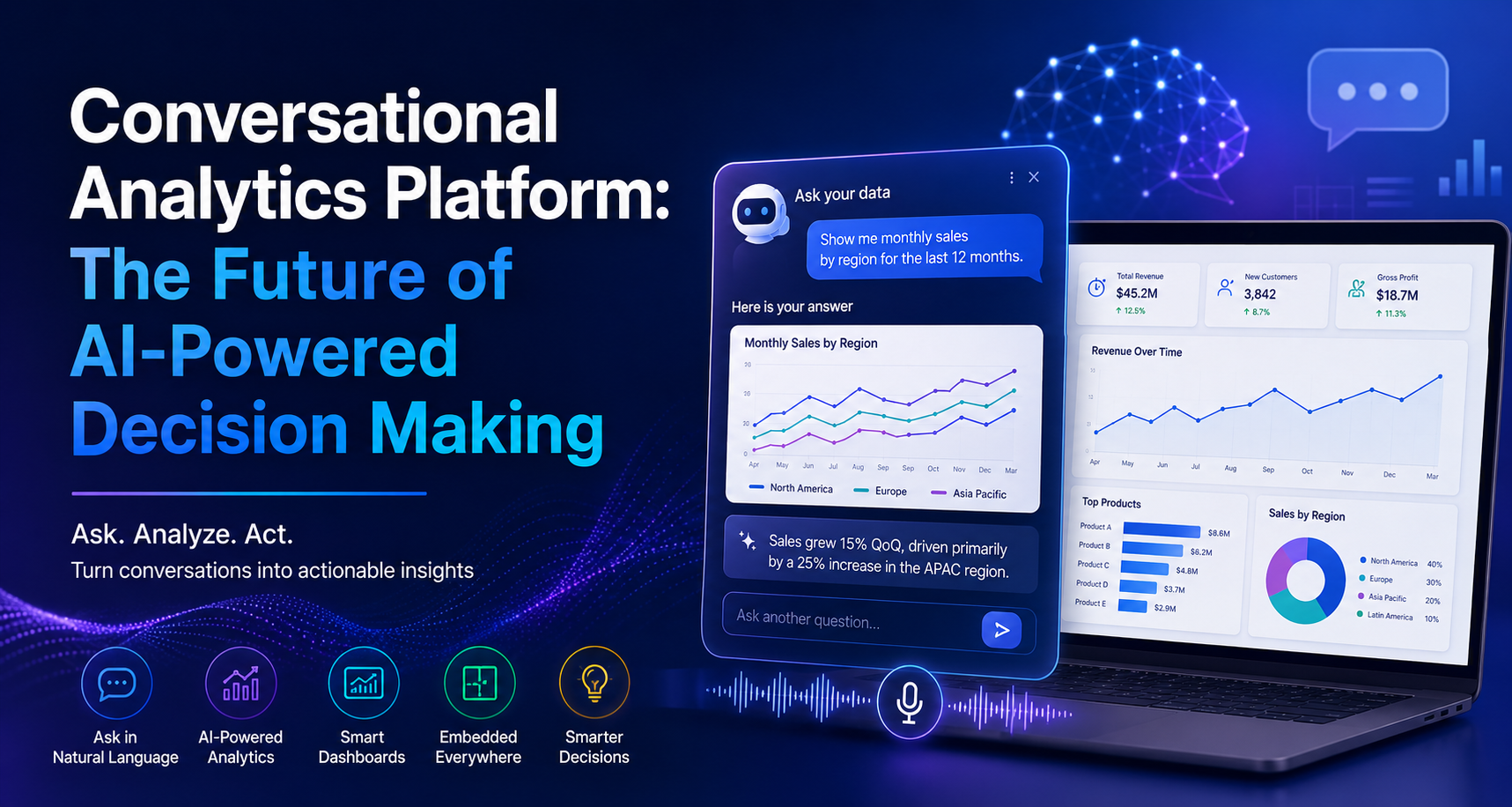
A conversational analytics platform is transforming how businesses interact with their data. Instead of navigating complex dashboards, writing SQL queries, or relying on analysts for every report, decision-makers can simply ask questions in natural language and get instant, intelligent answers. This shift from traditional BI to conversational BI is redefining self-service analytics and democratizing insights across the entire organization.
In this section, we’ll break down what a conversational analytics platform is, how AI-powered analytics and chat-based BI work, where dashboards and embedded analytics fit in, real-world use cases, key benefits, and the trends shaping its future. We’ll also explain how Helical Insight stands out as a powerful conversational analytics solution in this space.
Talk to Your Data in Real Time Using Helical Insight.
Transform natural language questions into instant dashboards, reports, and AI-powered insights.
What Is a Conversational Analytics Platform?
A conversational analytics platform is an AI business intelligence solution that lets users interact with data using natural language either through text or voice. Instead of clicking through layers of reports, users can type or speak questions like:
- “Show me monthly sales by region for the last 12 months.”
- “Which product category had the highest growth last quarter?”
- “Compare marketing spend vs revenue for EMEA.”
The system then uses natural language analytics to understand the question, runs the relevant queries on your data sources, and responds with charts, AI dashboards, tables, or narrative explanations in seconds.
At its core, a conversational analytics platform typically includes:
- AI powered analytics engine to interpret questions, detect intent, and generate accurate queries.
- Chat based analytics interface where users can ask questions and refine them in a conversational flow.
- An AI dashboard platform that can dynamically build or update dashboards based on user prompts.
- An embedded analytics platform capability to bring conversational BI directly into the applications and workflows employees already use.
- A GenAI analytics platform layer that can summarize insights, suggest follow-up questions, and generate data stories.
This combination makes it possible for non-technical users to perform chat driven data analysis independently, without being blocked by technical complexity.
How AI-Powered Analytics Drives Conversational BI
AI powered analytics is the engine that makes conversational BI possible. It typically includes several layers of intelligence:
Natural Language Understanding (NLU)
The platform must interpret what the user is asking, even when phrased differently. For example, “last quarter,” “previous quarter,” or “Q-1” should all map to the correct time period. NLU breaks down the question, identifies metrics, dimensions, filters, and intent, then translates it into a query.
Semantic Modeling
A strong AI business intelligence solution uses a semantic layer that maps business terms (“revenue,” “customer churn,” “gross margin”) to the underlying data model. This means business users don’t need to know table names or field structures; they can simply talk in business language.
Intelligent Query Generation
Once the question and semantics are understood, the platform builds optimized queries for the underlying databases, warehouses, or data lakes. Advanced systems can even choose the best visual representation—bar chart, line chart, table, KPI tile—depending on the question.
Generative AI for Insight Narratives
A modern GenAI analytics platform goes beyond charts. It can automatically generate textual insights such as:
- “Sales grew 15% QoQ, driven primarily by a 25% increase in the APAC region.”
- “Customer churn decreased by 3%, with the biggest improvement in enterprise accounts.”
This allows stakeholders to understand not just the numbers, but also the “so what?” behind them.
Continuous Learning
As users ask more questions, the system learns from interactions—improving its understanding of domain terminology, preferred visualizations, and typical analysis paths. Over time, the conversational BI experience becomes more accurate, personalized, and intuitive.
Talk to Your Data in Real Time Using Helical Insight.
Transform natural language questions into instant dashboards, reports, and AI-powered insights.
Chat-Based Analytics: From Queries to Conversations
Traditional BI is one-directional: you run a report, receive a static output, and if you need more detail, you ask a data analyst to drill down or modify it. Chat based analytics changes this into a back-and-forth conversation with your data.
A typical chat driven data analysis flow looks like this:
- Ask a broad question: “How did sales perform last month?”
- Get a quick visualization and summary.
- Refine: “Break this down by product category.”
- Drill deeper: “Filter to online channels only.”
- Explore anomalies: “Why did electronics drop in the North region?”
Each follow-up question builds on the context of the previous one. The conversational analytics platform remembers what you’re looking at and allows rapid iteration, just like chatting with a colleague who knows your data intimately.
This conversational BI approach is especially powerful because:
- It mirrors natural human thinking—starting broad and drilling down.
- It lowers the barrier to entry—no technical skills required.
- It encourages exploration—users are more willing to “ask another question” than to request a new report every time.
Dashboards in an AI Dashboard Platform
Contrary to a common misconception, conversational analytics doesn’t eliminate dashboards; it enhances them. An AI dashboard platform combines traditional dashboard capabilities with intelligent, chat-driven interactions.
Key ways dashboards evolve in this model:
- Dynamic Creation: Users can say, “Create a sales performance dashboard for the last year with revenue, profit, and top 10 products,” and the system auto-builds it.
- On-the-Fly Adjustments: Instead of manually editing filters and widgets, users can type, “Add a filter for region” or “Replace revenue with average order value.”
- Insight Overlays: GenAI analytics features can overlay narratives on dashboards—highlighting trends, outliers, and correlations without the user manually searching for them.
- Personalized Views: The AI learns what metrics each role cares about—sales, finance, marketing—and tailors dashboards accordingly.
The result is a living, breathing AI dashboard platform where dashboards are no longer static, but responsive to conversational prompts and constantly aligned with evolving business questions.
Embedded Analytics Platform: Bringing Insights Into Everyday Tools
The value of analytics multiplies when it appears where users already work. An embedded analytics platform capability is crucial for weaving conversational BI into daily workflows.
With embedded analytics, you can:
- Integrate chat based analytics directly into CRM systems, ERPs, HR platforms, or custom enterprise apps.
- Allow sales teams to ask, within their CRM, “What is the win rate trend for this segment?”
- Let customer success managers see natural language analytics about churn risk directly inside their customer management tools.
- Provide executives with a built-in conversational analytics widget in their intranet or executive portal for quick, ad-hoc queries.
Embedding a conversational analytics platform in existing applications drives adoption, boosts productivity, and ensures employees rely on data rather than intuition alone.
Talk to Your Data in Real Time Using Helical Insight.
Transform natural language questions into instant dashboards, reports, and AI-powered insights.
Use Cases of Conversational Analytics Across Industries
Conversational analytics platforms and AI powered analytics are highly versatile. Some common use cases include:
Sales and Revenue Operations
- Track pipeline health: “Show pipeline by stage and probability for this quarter.”
- Analyze performance: “Which reps exceeded quota last month?”
- Identify opportunities: “What accounts have high engagement but no recent opportunities?”
Marketing Analytics
- Campaign performance: “Compare ROI for our last three digital campaigns.”
- Audience insights: “Which segments respond best to email vs social ads?”
- Attribution analysis: “What channels most frequently appear in first-touch conversions?”
Finance and FP&A
- Budget vs actuals: “Show OPEX vs budget by department for year-to-date.”
- Cash flow monitoring: “What is the projected cash position next month?”
- Variance analysis: “Explain major variances in expenses this quarter.”
Operations and Supply Chain
- Inventory visibility: “Which SKUs are at risk of stockouts in the next two weeks?”
- Supplier performance: “Which suppliers have the longest lead times?”
- Logistics optimization: “Where are shipping delays most frequent?”
Customer Support and Experience
- Ticket analytics: “What are the top 5 complaint categories this month?”
- SLA tracking: “How many tickets breached SLA last week?”
- Sentiment analysis: “Summarize customer sentiment by product line.”
HR and People Analytics
- Hiring funnel: “Show time-to-hire by role for the last six months.”
- Attrition trends: “Which departments have the highest turnover?”
- Engagement: “Correlate employee engagement scores with performance ratings.”
Benefits of a Conversational Analytics Platform
- True Self-Service Analytics
Business users no longer wait days or weeks for new reports. Self service analytics becomes reality, as anyone can simply ask questions and explore answers independently. - Faster, Better Decisions
When data is available instantly through conversational BI, decision cycles compress. Managers can test multiple scenarios during a single meeting and respond quickly to emerging trends. - Broader Data Adoption
Because natural language analytics is more intuitive than complex BI tools, more employees actually use data in their day-to-day work. This builds a data-driven culture across the organization. - Reduced BI Backlog and Costs
Central BI teams spend less time building one-off reports and more time on high-value tasks such as data modeling, governance, and advanced analytics. This increases efficiency and lowers the total cost of BI. - Increased Accuracy and Consistency
With a robust semantic layer and governed AI business intelligence environment, everyone refers to the same definitions and metrics. This avoids the common “multiple versions of the truth” problem. - Enhanced User Experience
An AI dashboard platform that responds to conversational prompts is simply more pleasant to use. Users feel like they are “talking to their data,” not fighting with a tool.
Future Trends in Conversational Analytics and AI Business Intelligence
The evolution of conversational analytics platforms is just beginning. Several major trends are shaping the future:
Deeper GenAI Integration
GenAI analytics will increasingly move from summarizing existing data to suggesting new lines of inquiry. The system may proactively say, “I noticed a spike in returns in the last week; would you like to analyze the root cause?”
Voice-First and Multimodal Interfaces
Voice-based interactions will grow, especially for executives on the move. Users might ask their mobile device, “How did yesterday’s sales compare to the prior week?” and get answers with both voice and visual charts.
Prescriptive and Actionable Insights
Beyond descriptive and diagnostic analytics, conversational BI will become more prescriptive—recommending actions such as “Consider increasing inventory for Product X in Region Y based on the current demand trend.”
Tighter Integration with Operational Systems
Conversational analytics will blur the line between insights and action. For example, after identifying low-performing campaigns, a marketing manager could pause or adjust them directly from within the same GenAI analytics platform interface.
Industry-Specific Conversational Models
Domain-specialized natural language analytics models will emerge for sectors like healthcare, banking, retail, and manufacturing, understanding their unique terminology and metrics out-of-the-box.
Stronger Governance and Explainability
As AI powered analytics becomes central to decision-making, organizations will demand transparent logic, audit trails, and robust governance to ensure trustworthy and compliant insights.
Helical Insight: Conversational Analytics Solution
Helical Insight is a modern AI business intelligence and analytics platform that aligns strongly with this vision of conversational analytics. It brings together self service analytics, an AI dashboard platform, and embedded analytics platform capabilities, while increasingly incorporating chat based analytics and natural language analytics features.
Key strengths of Helical Insight as a conversational analytics solution include:
- Flexible Architecture: It supports multiple data sources, deployment options, and extensive customization—allowing organizations to design a conversational BI environment that fits their existing technology stack.
- AI Powered Analytics: Through its intelligent query generation and advanced visualization capabilities, Helical Insight helps users generate content such as dashboards, reports, and data stories quickly and accurately.
- Self-Service and Developer-Friendly: Business users can explore data independently, while developers and data teams can extend and embed the platform. This dual focus makes it a strong foundation for a GenAI analytics platform experience.
- Embedded Analytics: Helical Insight can be embedded into existing applications, enabling chat driven data analysis and AI dashboard experiences directly where users work.
- Roadmap for Conversational BI: With growing adoption of conversational analytics patterns, Helical Insight is well positioned to serve as a central conversational analytics platform for organizations seeking both flexibility and AI-driven intelligence.
By leveraging Helical Insight as a conversational analytics solution, organizations can move beyond static reporting and empower every user to “talk to their data” in real time, using natural language, across web, mobile, and embedded contexts.
Talk to Your Data in Real Time Using Helical Insight.
Transform natural language questions into instant dashboards, reports, and AI-powered insights.
FAQs: Conversational Analytics Platforms
What is a conversational analytics platform?
A conversational analytics platform is an AI powered analytics solution that lets users interact with data using natural language, via text or voice. Instead of relying on predefined reports, users ask questions conversationally and receive visualizations, metrics, and AI-generated insights in response.
How is conversational BI different from traditional BI?
Traditional BI requires navigating dashboards, understanding filters, and often relying on technical teams to build new reports. Conversational BI uses chat based analytics and natural language analytics so users can simply ask questions like they would with a colleague. It lowers the technical barrier and encourages broader data use.
Do conversational analytics platforms replace dashboards?
No. Dashboards remain important, but they evolve. An AI dashboard platform allows users to create, modify, and explore dashboards conversationally. Dashboards become more dynamic and easier to maintain, rather than being static, one-off creations.
Can conversational analytics be embedded into existing applications?
Yes. Many platforms, including Helical Insight, offer embedded analytics platform capabilities. This allows you to bring chat driven data analysis and AI business intelligence into CRMs, ERPs, intranets, or custom apps, so users can access insights in the context of their daily work.
Is conversational analytics secure and governed?
A well-designed conversational analytics platform uses role-based access control, row-level security, and governed semantic models. This ensures that users see only the data they are authorized to see and that everyone uses consistent definitions for metrics and KPIs.
What technical skills are required to use a conversational analytics platform?
End-users need almost no technical skills beyond being able to express their questions clearly in natural language. Data and BI teams, however, are still needed to set up data connections, models, and governance. Once configured, the environment enables true self service analytics for business users.
Why consider Helical Insight for conversational analytics?
Helical Insight offers a flexible, extensible AI business intelligence environment with strong self service analytics, AI powered analytics features, and embedded analytics platform capabilities. Its architecture and roadmap make it a compelling choice for organizations that want to adopt conversational BI, natural language analytics, and GenAI analytics platform experiences without being locked into rigid, proprietary systems.
For any help or queries regarding Helical Insight, feel free to reach out to us at support@helicalinsight.com.
